Redesigning an education SaaS product model

Connecting how schools are organized to the product model, access, configuration and commercial choices.

Situation
An education software product needed to represent how schools organized their work. Existing designs and work breakdowns needed to be revisited against the actual workflows and business rules.
My part
I contributed to domain discovery and product-model redesign, working with business and technical colleagues. This included clarifying questions and assumptions, documenting business rules and connecting them to a revised model.
Supported result
The result was a redesigned product model and a handoff for implementation. Production use of the full design and its business impact remain unconfirmed.

When the operating context changes the product

An education software product needed to represent how schools organized their work. Existing designs and work breakdowns needed to be revisited against the actual workflows and business rules.

The discovery covered work being managed through spreadsheets, email and documents, including scheduling, grading and reporting. Those activities helped make the questions behind the software model more concrete.

My contribution

I contributed to domain discovery and product-model redesign, working with business and technical colleagues. This included clarifying questions and assumptions, documenting business rules and connecting them to a revised model.

My work focused on discovery and the product model, alongside the team's engineering work.

Connect the organization to the product choices

I redesigned a multi-tenant education SaaS product model connecting organizational structures to role-based access, white-label configuration, pricing and usage metering.

In practical terms, those choices concerned how organizations and users would be represented, which actions different roles could take, what could be configured for different organizations, and how pricing could relate to use.

New explanatory illustration of the model relationships
Model choiceOperating questionConnected definition
OrganizationWhich school or organization does this work belong to?Tenant structure
RoleWhich actions may this person take?Permissions
ConfigurationWhat varies between organizations?White-label settings
Commercial useWhat does the pricing model count?Pricing and usage metering

The revised data model was connected to requirements and work estimates, giving the development team a defined scope for implementation.

The handoff and its limits

The result was a redesigned product model and a handoff for implementation. Production use of the full design and its business impact remain unconfirmed.

A question to take into your own project

Before treating a design as ready to build, ask whether it represents the people, organizations and rules the product must support. A more detailed plan can still depend on an assumption that needs another look.

Consider the questions for an idea or first release

Read the reasoning about shared investment

Use the guide before committing to software or AI

Keep a waiting decision moving

Making the handoff reviewable

The useful connection was between the organizational model and the decisions built on top of it. Roles, configurable behavior and usage-based pricing cannot be treated as separate screen features if they describe the same organization. I connected those questions to the revised model and the requirements handed to the development team.
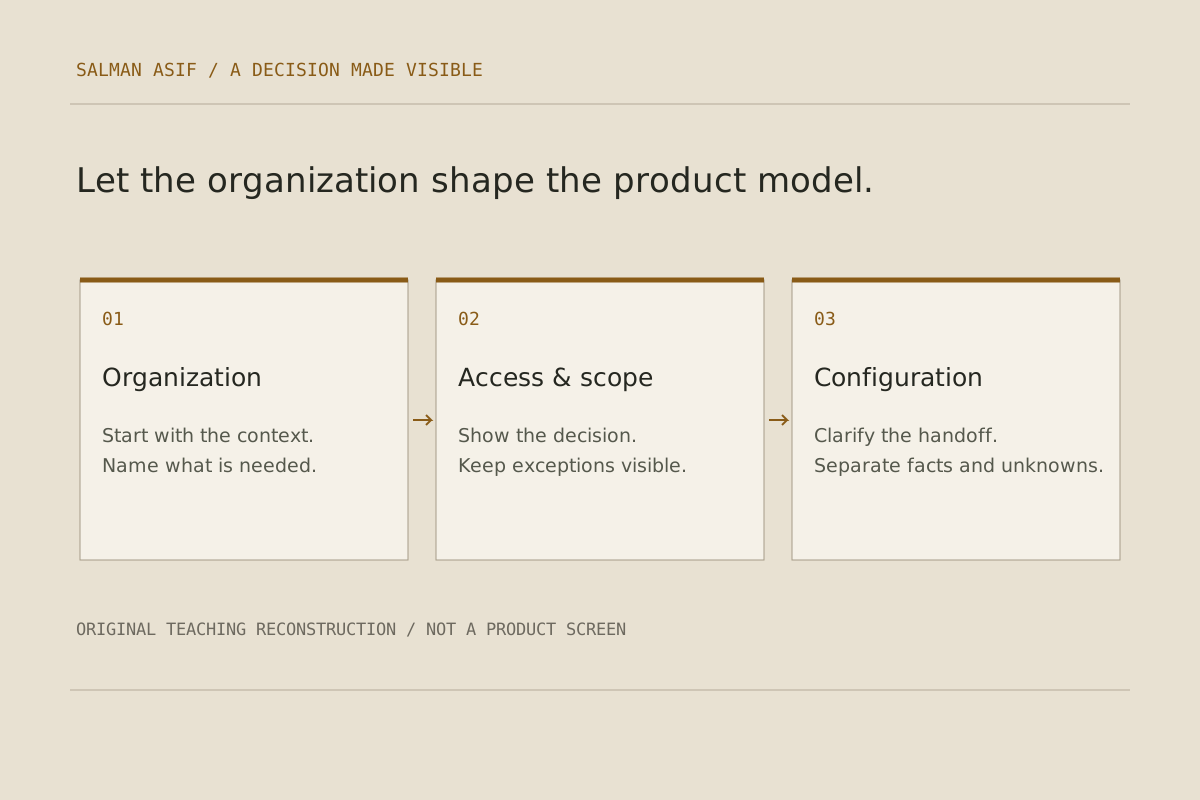
Reconstructed teaching illustration

Let the organization shape the product model

Access, configuration and pricing depend on how the product represents the organizations and people using it. Review those relationships together.

  1. 01

    Organizational context

    Which organizations, people and working relationships must the model represent?

  2. 02

    Roles and access

    Which actions can each role take, and within which boundary?

  3. 03

    Configuration

    What can vary between organizations without changing the shared meaning?

  4. 04

    Pricing and usage

    Which units of use does the commercial model need to recognize?

An assumption no longer fits

Which relationship or business rule needs another discovery conversation before the implementation scope becomes more precise?

An original explanatory relationship map, not the original project data model or a claim that every designed capability entered production.
  1. Review the model behind the screen

    A detailed interface can still depend on an organizational assumption that needs to be questioned. More detail does not resolve that assumption.

  2. Connect the handoff

    Requirements and estimates become more useful when the receiving team can see the model and business rules they rely on.

  3. Separate design from adoption

    A model and implementation handoff are tangible outputs. They do not by themselves demonstrate production use or commercial impact.

What would be useful to clarify?

You can start with the decision, the context and what remains uncertain.

Start a conversation

Bring the situation and the questions you would like to discuss.

A closer look

Open the image on its own →

Continue the thinking

Read at your own pace.

Browse the writing · Follow Salman on Substack

Follow the writing with RSS Subscribe to newly published writing in your feed reader.

Prefer email updates or a contribution?

Email signup is not connected. Use the public profile above; no email address is collected here.

For a possible guest contribution or collaboration, prepare a short conversation brief. Editorial review and permission come before publication.