Making marketplace milestones and payout rules inspectable

Supporting transaction-workflow definition, business-rule review and engineering/QA handoffs for a service marketplace.

Situation
A service marketplace connected project-based work with milestones and payouts. Defining the transaction workflow meant making the business rules visible: what a milestone represented, what could trigger a payout, and where a disagreement needed handling.
My part
My role was a supporting business-analysis and technical coordination contribution. The supported baseline is transaction-workflow definition, integration-validation criteria and handoffs. Engineering implementation remained with the development team.
Supported result
The case is bounded to supporting rule review, workflow definition and delivery handoffs. Production operation, deployed providers, compliance assurances and measured payment or business outcomes are not established by this account.

A transaction needs more than a payment action

A service marketplace connected project-based work with milestones and payouts. Defining the transaction workflow meant making the business rules visible: what a milestone represented, what could trigger a payout, and where a disagreement needed handling.

My role was a supporting business-analysis and technical coordination contribution. The supported baseline is transaction-workflow definition, integration-validation criteria and handoffs. Engineering implementation remained with the development team.

Connect business behavior to reviewable rules

The supporting review covered milestone handling, payout-release conditions, fees and dispute workflows. These are related decisions: a completed task, an accepted milestone and a released payment describe different states. Keeping that meaning explicit gives engineering and QA a clearer behavior to discuss.

Delivery coordination included requirements clarification, QA handoff support and demonstrations. The useful contribution was connecting intended transaction behavior with the questions a delivery team needed to resolve. The available record does not establish which particular rule changed after review.

New explanatory illustration of review questions; not an original project artifact
Transaction boundaryQuestion to confirmReceiving responsibility
Milestone reviewWhat records agreement that the milestone is accepted?Product and engineering clarify the rule
Payout eligibilityWhich conditions permit release, and which hold it?Engineering and QA confirm expected behavior
Disputed or ambiguous stateWho reviews the case before a further action?A named operating owner resolves the exception

Make the receiving team’s questions explicit

Workflow definition and validation criteria provide a basis for checking the normal path and exceptions. A useful handoff also identifies who confirms completion when a transaction crosses systems. An accepted request alone should not be described as a completed payout.

The case is bounded to supporting rule review, workflow definition and delivery handoffs. Production operation, deployed providers, compliance assurances and measured payment or business outcomes are not established by this account.

A question for a similar marketplace

Before committing a transaction workflow, ask which business state permits the next action, who can confirm that state and what happens when confirmation is disputed or missing. Use the integration map to make those questions concrete.

Map an integration handoff

Carry a decision into the next team

Keep a waiting decision moving

Making the handoff reviewable

Task completion, milestone acceptance and payout release describe different states. The supporting review connected those meanings to the workflow questions engineering and QA needed to check. The available record supports that definition and handoff work; it does not establish which payout rule changed after review or the performance of a production payment service.
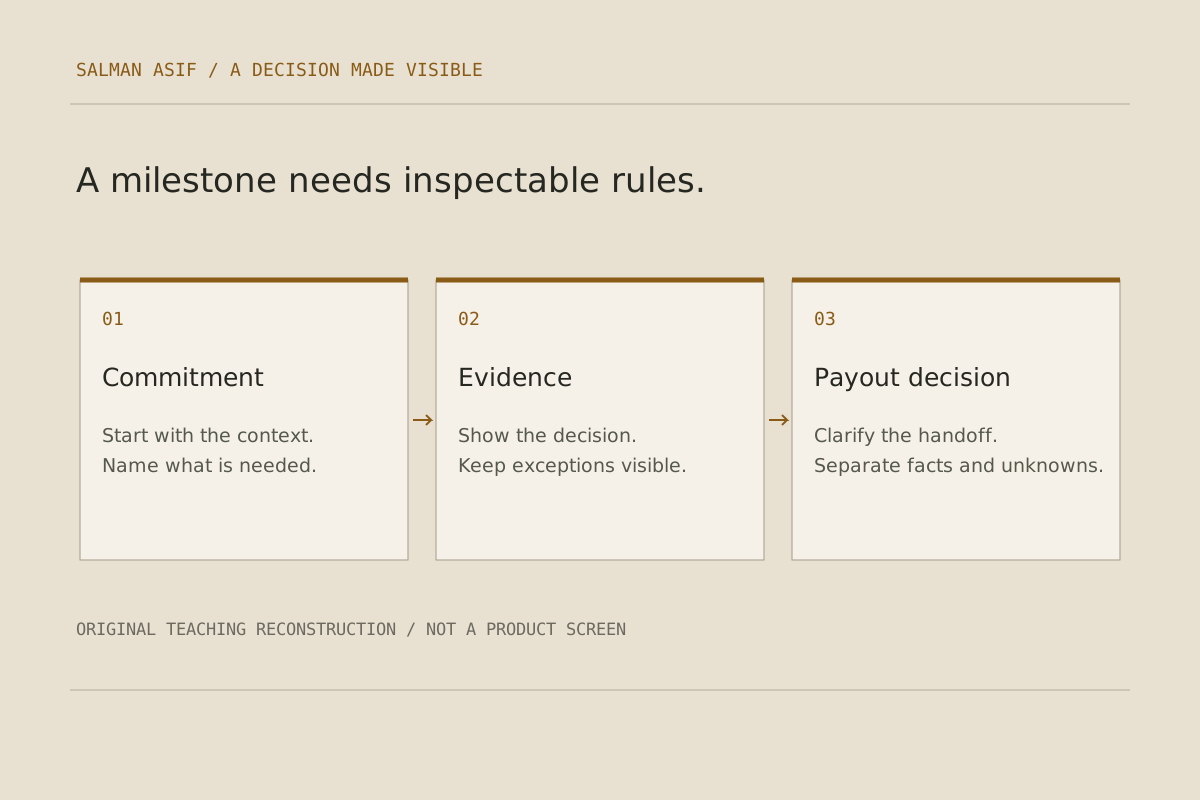
Reconstructed teaching illustration

Separate the states before connecting them

Completion, acceptance and eligibility describe different business states. This view turns their boundaries into review questions rather than assuming one proves the next.

  1. 01

    Work completed

    What evidence describes the work being complete?

  2. 02

    Milestone reviewed

    Who records acceptance, a requested change or a dispute?

  3. 03

    Payout eligible

    Which confirmed conditions permit release, and which hold it?

  4. 04

    Outcome confirmed

    What confirms the intended action completed, rather than only that a request was accepted?

Disputed or unconfirmed state

Who reconciles the case before another action, and which evidence is still missing?

An original transaction-review example, not an original project artifact, implemented contract rule or assurance about a payment service.
  1. Do not collapse the states

    A completed task, an accepted milestone and an eligible payout require their own meanings and confirmation.

  2. Give QA a behavior to inspect

    Workflow definitions and validation criteria can describe the normal path alongside disputed or ambiguous outcomes.

  3. Preserve the contribution boundary

    This view explains rule review and delivery handoffs. It does not claim personal payment implementation, production stability or compliance assurance.

What would be useful to clarify?

You can start with the decision, the context and what remains uncertain.

Start a conversation

Bring the situation and the questions you would like to discuss.

A closer look

Open the image on its own →

Continue the thinking

Read at your own pace.

Browse the writing · Follow Salman on Substack

Follow the writing with RSS Subscribe to newly published writing in your feed reader.

Prefer email updates or a contribution?

Email signup is not connected. Use the public profile above; no email address is collected here.

For a possible guest contribution or collaboration, prepare a short conversation brief. Editorial review and permission come before publication.