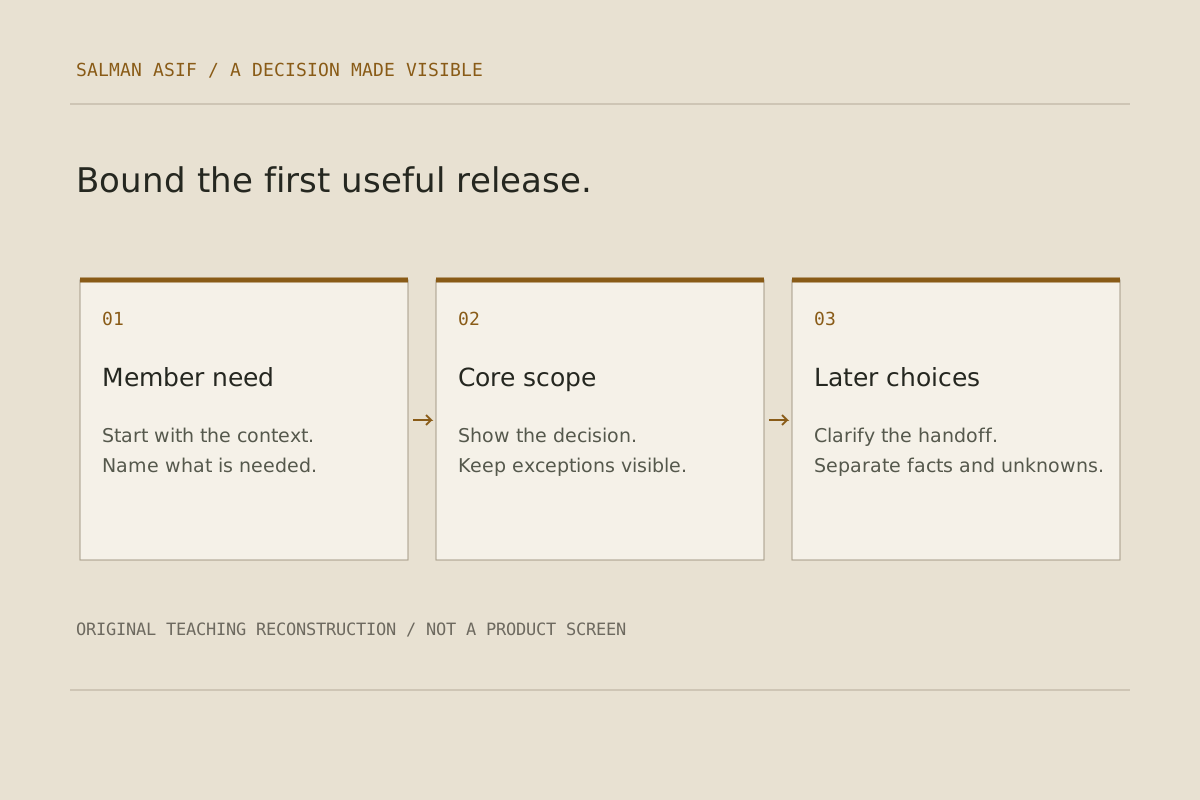
A familiar category still needed a clear product scope
A professional networking and portfolio concept aimed to help people present project-based skills and connect directly. Established networking and portfolio platforms provided useful comparisons, but a familiar feature list would not by itself explain which experience the first version should deliver.
Balance feature completeness with a usable first version
My business-analysis work included competitor research, user journeys and MVP prioritization. The scope decision concerned the balance between feature completeness and time to market. I organized the proposed work by priority and translated it into a backlog rather than treating every feature as equally necessary for the first version.
Prioritization gave the team an ordered scope for engineering discussion. Whether a particular feature would make the product distinct still needed user evidence. The planning output should be read at that stage.
Connect the backlog to the behavior people would use
I prepared a work breakdown, epics, user stories and acceptance criteria, including permissions, edge cases and validation failures. Annotated wireframes covered onboarding, profiles, feed interactions, messaging and notifications. Process and state diagrams connected user actions to system behavior.
I collaborated with developers on architecture and service-integration questions and clarified messaging behavior. That was product and requirements collaboration; it does not mean I personally implemented the application or its integrations.
A planning and clarification result
The tangible output was an MVP scope and delivery backlog supported by wireframes, workflows and acceptance criteria. Profile completion, connection activity and other product measures were proposed for evaluation. They are not reported here as measured adoption or engagement improvements.
This case is bounded to discovery, planning and engineering clarification. It makes no launch, production-scale or commercial-outcome claim.
Keep prioritization and validation as separate decisions
My reflection is that a prioritized backlog helps a team choose what to build next, while a separate question remains: does that choice give the intended user a reason to use the product? Treating those as separate decisions makes it possible to narrow a first version without presenting prioritization as proof of demand.
Explore help shaping a first useful release
Compare investment options before committing
Write a brief for the next useful pilot
Keep a waiting decision moving
Making the handoff reviewable
The backlog connected feature priority to the behavior people would encounter: who could act, what a valid action meant and what should happen at an edge case. That made the scope discussable with developers. It did not by itself validate a reason for people to choose a new networking product, so prioritization and demand validation remain separate conclusions.