An existing service with competing demands
A wellness mobile product was already live and had bugs and performance concerns alongside requests for new social and activity features. The work called for a clearer view of what users were encountering and which changes deserved attention first.
The mobile team initially worked with a separately managed backend. Requests for backend changes passed through the client to another team. A mobile release plan therefore depended on work beyond the immediate team’s control.
My contribution
I managed roadmap and backlog priorities. An audit brought bugs, interface issues and performance gaps into a triage backlog, with priority based on severity and user impact. I organized the work into release and feature plans.
I also worked with QA on test scenarios, crash reports and regression checks. Engineers implemented the product changes; my contribution was prioritization, requirements and coordination across those delivery boundaries.
Stability before broader feature expansion
The prioritization work put production stability ahead of broad feature expansion. Severity and user impact gave the team a basis for ordering defects alongside enhancement requests.
That choice still had to account for ownership. Work the mobile team could address and work requiring a backend change had different dependencies. Keeping those dependencies visible was part of making the release plan useful.
A backlog connected to release planning
The concrete artifacts included a spreadsheet-based triage backlog, release and feature groupings in the delivery tracker, and test scenarios developed with QA. These connected the issues being assessed to planned delivery and validation.
I defined adoption, crash-monitoring and city-expansion KPIs as ways to assess the product. Defining those measures is separate from demonstrating an improvement in them.
Work on a product that was already live
This case covers roadmap and backlog management, release planning and QA coordination for an existing service. It does not quantify changes in adoption, crash rates or user satisfaction. The scope of particular later releases is left open.
A question for a similar situation
When prioritizing an existing product, ask which user problems matter most and which team can actually change the behavior behind them. A high-priority item still needs an owner and a workable route through its dependencies.
Explore help with an existing product or business constraint
Use the software and AI decision guide
Keep a waiting decision moving
Making the handoff reviewable
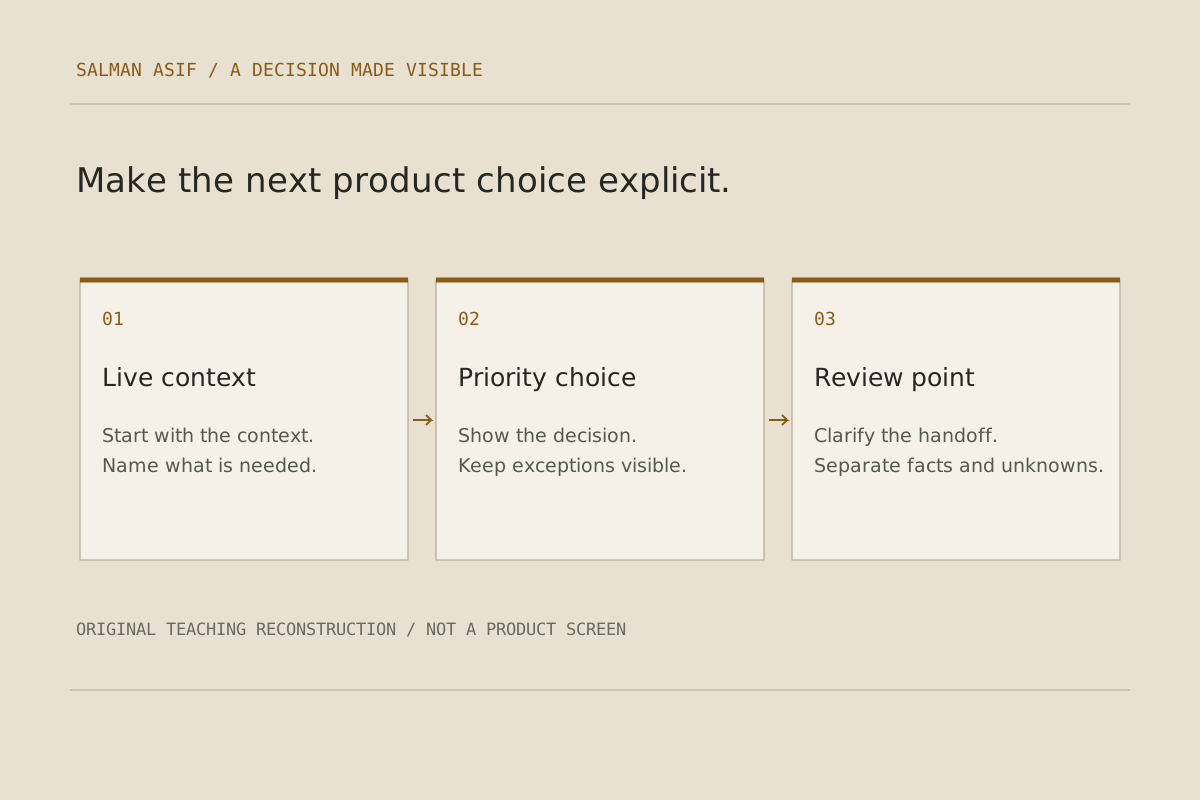
A release plan needed two views at once: how much a problem affected users and which team could change the behavior behind it. I used the triage backlog to connect severity and user impact to release planning, while keeping backend-dependent work visible rather than treating it as immediately deliverable by the mobile team.